
If you wait for your insurance adjuster to tell you what your repairs are worth, you've already lost. Mastering the storm damage insurance claim process in 2026 requires more than just filing a report; it demands a strategic defense of your property's value. You already know the stress of managing a leaking roof while drowning in complex paperwork. The fear of a claim denial or a "storm chaser" scam is real, especially as insurers implement more rigorous assessments and move away from standardized policy language. You deserve a partner who acts as a protective shield for your home and your financial security.
This guide ensures you can secure a fully restored property with zero out-of-pocket expenses beyond your deductible. We'll explore the latest 2026 regulations, including the new human-review requirements for AI-driven denials and the critical changes to roof replacement coverage from Fannie Mae and Freddie Mac. You'll learn how to transform a confusing, high-stakes scenario into a transparent, fast-tracked repair project that restores your peace of mind. We'll walk through the documentation strategy needed to hold providers accountable and get your home restoration fully funded.
Key Takeaways
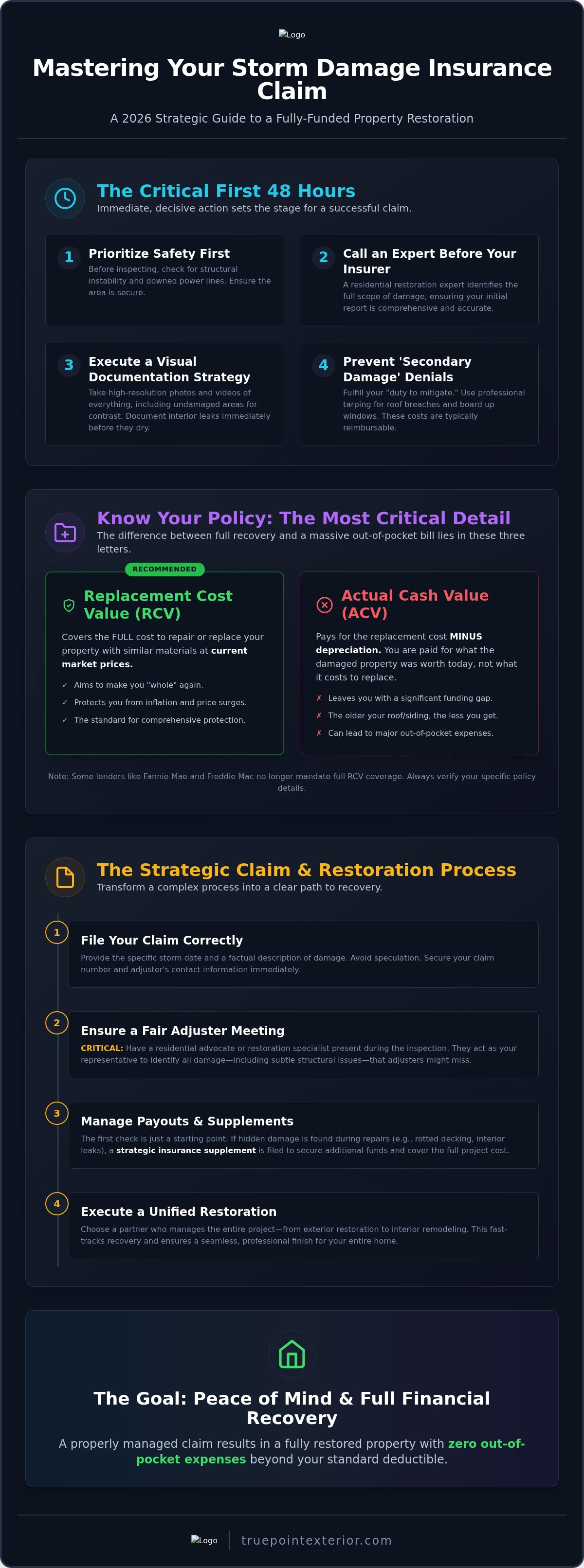
- Act within the first 48 hours to document all damage and prevent further property loss through immediate temporary repairs and high-resolution evidence.
- Navigate the storm damage insurance claim process with confidence by distinguishing between Replacement Cost (RCV) and Actual Cash Value (ACV) policies.
- Ensure a fair assessment by having a residential advocate present during the adjuster’s inspection to identify all structural and solar damage.
- Secure additional funding for hidden leaks or structural issues discovered during repair through a strategic insurance supplement process.
- Fast-track your recovery by choosing a partner who manages both exterior restoration and interior remodeling for a unified, professional repair experience.
Immediate Steps: What to Do Within 48 Hours of Storm Damage
The 48-hour window following a severe weather event determines the success of your recovery. Your priority is immediate safety; ensure the structure is stable and there are no downed power lines before inspecting the exterior. Once safe, contact a residential restoration expert before you call your insurance agent. This proactive step allows a professional to identify the full scope of damage, ensuring your initial report is accurate and comprehensive. Starting the storm damage insurance claim process with an expert evaluation prevents you from overlooking subtle structural issues that could lead to a denial later.
Identify the specific details of the weather event. Record the exact date and time the storm hit your neighborhood. If hail occurred, note the approximate size; if wind was the primary factor, look for local reports on peak gusts. These facts provide the necessary context for your claim and help verify that the damage aligns with a specific, covered peril. Having these details ready shows the insurance carrier that you are organized and serious about your property's restoration.
Visual Documentation Strategy
High-resolution imagery is your most powerful tool. Capture photos and video of every exterior surface, including areas that appear unaffected. This contrast proves the severity of the impacted sections to the insurance carrier. Look beyond obvious holes in the roof. Focus on "bruised" shingles where the protective mat has been weakened, dented soft metals on roof vents, and heavy accumulations of granules in your gutters. If the storm caused leaks, photograph interior ceiling stains and wet drywall immediately. These interior signs often dry or change appearance quickly, so capturing them in real-time is vital for proving the storm's direct impact on your home's interior.
Preventing 'Secondary Damage' Denials
Most homeowners realize that understanding your property insurance policy involves knowing what is covered, but few recognize their "duty to mitigate." This clause requires you to take reasonable steps to prevent further loss after the initial event. If you leave a roof puncture open to the elements and a second rainstorm causes interior flooding, the insurance company may deny coverage for that subsequent water damage. They expect you to act decisively to protect the structure.
Utilize professional tarping services for roof breaches and board up broken windows immediately. These are not permanent repairs; they are protective measures designed to secure your property while you navigate the storm damage insurance claim process. Keep every receipt for emergency materials and professional mitigation services. These costs are typically reimbursable and demonstrate to your provider that you are actively protecting the asset. This thorough approach simplifies the logistics and ensures your eventual restoration remains fully funded.
Filing Your Claim: A Step-by-Step Guide to the Paperwork
Filing a claim is a precise legal action that dictates your financial outcome. Before calling your carrier, review your policy to determine if you have Replacement Cost Value (RCV) or Actual Cash Value (ACV). RCV policies are designed to cover the full cost of restoration at current market prices. In contrast, ACV policies only pay the depreciated value of your property. Recent shifts in the industry mean some lenders, like Fannie Mae and Freddie Mac, no longer mandate full replacement cost coverage. Knowing your specific coverage level prevents surprises when the first check arrives. The National Association of Insurance Commissioners (NAIC) offers detailed guidance to help you navigate the insurance claims process and understand these technical distinctions.
Initiate the claim by providing the specific storm date and a brief, factual description of the damage. Avoid speculative language; stick to the visible evidence gathered in your initial 48-hour inspection. Once the claim is open, secure your claim number and the direct contact information for your assigned adjuster. This number is the key to every future communication. Prepare your "Evidence Portfolio," which should include the high-resolution photos, weather data, and professional repair estimates you've collected. This organized approach forces the insurance company to respond to facts rather than generalities.
Understanding Your Deductible
Calculate your out-of-pocket maximum before the project begins. Many modern policies feature a separate Wind/Hail deductible, which is often a percentage of your home’s total insured value rather than a flat dollar amount. This can significantly impact your initial costs. Be wary of any contractor offering to "waive" or "absorb" your deductible. This practice is illegal in many states and often indicates that a contractor plans to cut corners on materials or labor to cover the cost. A transparent, fast-tracked repair process relies on honest financial handling from the start.
The Role of the Restoration Contractor
Your restoration expert is your primary logistical partner. They should be your first call because they identify damage that an untrained eye might miss. A professional estimate differs from an insurance "scope of loss" because it reflects actual local labor rates and material availability. Ensure your contractor uses Xactimate, the industry-standard estimating software. This alignment ensures that both parties speak the same language, which minimizes disputes over pricing. Utilizing professional insurance claims assistance ensures your documentation is formatted for immediate approval, keeping the storm damage insurance claim process moving toward a fully funded restoration.
The Adjuster Meeting: How to Ensure a Fair Damage Assessment
The insurance adjuster’s visit is the most critical phase of the storm damage insurance claim process. This meeting determines the initial scope of work and the funding available for your restoration. You should never host an adjuster alone. Instead, schedule the inspection when your residential restoration expert can also be present. This creates a unified team that reviews the roof, siding, and solar panels simultaneously. A professional contractor ensures the adjuster identifies collateral damage on secondary structures like fences, decks, and AC units. These items are often overlooked but are essential components of a fully funded claim.
Demand a thorough "test square" assessment for hail impact density. This involves marking a 10-by-10-foot area on each slope of the roof to count the number of hits. Adjusters often perform a cursory glance, but a rigorous count provides the data needed to justify a full replacement rather than a localized repair. By establishing these facts on-site, you reduce the likelihood of a low-ball settlement or a partial denial.
Why Contractor Presence Matters
Contractors speak the technical language of insurance adjusters. They use industry-standard terminology to justify why specific repairs are necessary under the current policy terms. During a quick walk-through, an adjuster might miss "hidden" damage like hairline cracks in siding or fractured roof matting. Having an advocate on the roof ensures no damage is left off the initial report. This proactive oversight prevents the need for multiple re-inspections and speeds up your project timeline. It transforms the meeting from a one-sided assessment into a collaborative professional review.
Common Adjuster Oversights
Adjusters frequently miss technical damage related to modern home technology. This includes impact damage to solar panel mounting hardware or micro-inverters that may have been jarred during a storm. Beyond the visible surfaces, they often underestimate the cost of local building code requirements. For example, many municipalities now require an ice and water shield on all roof eaves, a cost that must be included in the estimate.
Another common error is ignoring "line of sight" rules for siding and roofing uniformity. If your siding is damaged on one side of the house and the original material is discontinued, the insurance company may be required to replace all siding to maintain a consistent appearance. A professional advocate identifies these requirements early, ensuring your home’s aesthetic and structural integrity are preserved. Addressing these technical details during the initial meeting is the best way to secure a transparent, fast-tracked repair process.
Managing Denials and Supplements: What to Do if the Payout is Low
Receiving an initial settlement check that fails to cover your actual repair costs is a common hurdle in the storm damage insurance claim process. Do not accept the first offer as final. Instead, analyze the "Scope of Loss" document provided by your insurer. This document often contains incorrect measurements or omits essential line items required for a professional restoration. If your carrier offers a partial repair for a roof that clearly requires a full replacement, you must challenge the technical feasibility of that repair. A "patchwork" fix often violates manufacturer warranties and local building codes, leaving your home vulnerable to future leaks.
When you and the insurer cannot agree on the value of the loss despite providing evidence, you have the right to utilize the "Appraisal Clause" found in most residential policies. This clause allows both parties to hire independent appraisers to determine the fair cost of repairs. The Appraisal Process is a binding way to resolve price disputes without a lawyer. It serves as a final, professional mechanism to ensure your settlement reflects the true market cost of labor and materials in 2026.
The Power of the Supplemental Claim
Supplemental claims are a standard part of the restoration process. They account for hidden damage discovered only after the teardown begins, such as rotted decking beneath old shingles or compromised solar mounting brackets. Supplements also cover "code upgrades" mandated by local municipalities in Pennsylvania or Texas. If a city inspector requires specific ice and water shields or high-wind fasteners not included in the original estimate, a supplement ensures these costs are covered. True Point Exterior manages the entire supplement paperwork trail, providing the photographic proof and building code citations needed to maximize your claim and keep the project fully funded.
When to Fight a Denial
Insurers often deny claims by categorizing storm damage as "wear and tear" or "pre-existing maintenance issues." If you have documented proof of a sudden weather event, you should immediately request a re-inspection. Demand that a different adjuster or a field supervisor visit the property to provide a second opinion. This is particularly important if your claim was initially processed by AI; remember that 2026 regulations require a human review for any claim reduction or denial. If your settlement is stalled or unfairly low, contact True Point Exterior for professional insurance claims assistance to protect your property's value.
Restoration and Recovery: Choosing a Residential Specialist
The final stage of the storm damage insurance claim process involves transitioning from documentation to physical restoration. Selecting a contractor who understands the local climate of the Northeast and Texas is vital for a successful recovery. Regional weather patterns dictate specific material requirements. In Texas, you need materials that resist thermal expansion and high-velocity wind gusts. In Pennsylvania or Connecticut, the focus shifts to preventing ice dams and managing heavy snow loads. A residential specialist ensures your home isn't just repaired, but reinforced against the specific threats of your local environment.
Finalizing your claim requires submitting a final "Proof of Loss" and a Certificate of Completion to your insurance carrier. These documents signal to the insurer that the scope of work is finished according to the agreed-upon estimate. This step is essential for releasing the "recoverable depreciation" payment, which is often the final portion of your funding. The Certificate of Completion is a legal declaration that the property is restored to its pre-storm condition. Without this paperwork, the insurance carrier may withhold funds, leaving you responsible for the remaining balance. A professional partner manages this final exchange to ensure you reach a zero out-of-pocket outcome.
Integrated Exterior and Interior Care
Hiring one team to manage your roof, solar, and interior repair reduces logistical stress significantly. When a storm causes a roof leak, the damage rarely stops at the shingles. Water often migrates into the attic and through the ceiling, requiring professional interior remodeling to restore your home’s aesthetic. True Point Exterior provides a single point of contact for the entire restoration. This unified approach ensures that the interior remodeling matches your existing textures and colors perfectly. You avoid the headache of coordinating multiple subcontractors and keep the project on a fast-tracked timeline.
Solar System Integrity Post-Storm
Standard roofers should never touch your solar panels. Modern energy-efficient homes require a higher level of technical expertise during the restoration phase. After a hail event, panels can develop micro-cracks that aren't visible to the naked eye but will eventually cause electrical faults. Solar-aware restoration involves checking the mounting hardware and micro-inverters for structural integrity. Maintaining your solar warranty requires professional technical support from a team that understands how to safely detach and reset these systems. This specialized care ensures your energy production remains steady and your long-term investment is protected. By choosing a solar-aware partner, you ensure the storm damage insurance claim process covers the technical nuances of your modern home.
Secure Your Home’s Future with Professional Advocacy
Navigating the storm damage insurance claim process shouldn't be a solitary burden. Success in 2026 requires meticulous documentation, an understanding of technical policy shifts, and a partner who manages the complex supplement paperwork. You've learned that acting within 48 hours and ensuring a contractor is present for the adjuster meeting are the most effective ways to protect your property's value. Whether you're dealing with hail-impacted solar panels or interior leaks that require professional remodeling, integrated expertise ensures your home restoration is fully funded and built to last.
True Point Exterior provides the technical specialization and logistical support needed to handle every stage of your recovery. We offer expert insurance claims assistance and specialized solar support across PA, TX, CT, RI, and NJ. Don't leave your settlement to chance or settle for a low-ball repair offer. Get a Professional Storm Damage Assessment from True Point Exterior today. Your home is your most significant asset; let us act as your protective shield and ensure your peace of mind.
Frequently Asked Questions
Will filing a storm damage claim cause my insurance rates to go up?
Generally, insurance carriers cannot raise your individual rates for a single "Act of God" claim like hail or wind damage. However, they may adjust premiums for an entire geographic area based on the frequency of severe weather in regions like Texas or Pennsylvania. Filing a claim is often necessary to protect your property's value, as you're already paying for this protection through your monthly premiums.
How long do I have to file a claim after a storm in Pennsylvania or Texas?
Most policies require "prompt notice" of a loss, which typically translates to a one-year window from the date of the event. In Texas and Pennsylvania, specific statutes of limitations for 2026 vary, so acting within 365 days is the safest strategy to avoid a denial based on late reporting. Delaying your filing can make it harder to prove that the damage was caused by a specific storm rather than gradual wear.
Can I hire my own contractor, or do I have to use the insurance company's preferred vendor?
You have the legal right to hire any residential specialist you choose for your home restoration. Preferred vendors often have pre-negotiated rates with the insurance company, which may lead to cost-cutting measures. Hiring an independent advocate ensures that your interests are prioritized during the storm damage insurance claim process. We provide an unbiased assessment of your roof, solar panels, and interior needs to ensure your home is fully restored.
What happens if the insurance check is made out to both me and my mortgage company?
This is a standard procedure across Connecticut and the Northeast because the mortgage lender has a financial stake in your home's integrity. You'll need to send the check to your lender's loss draft department for endorsement. They typically hold funds in an escrow account and release payments in stages as the work reaches specific milestones. We provide the necessary documentation and certificates of completion to help fast-track this fund release process.
What is the difference between RCV and ACV in a roof claim?
Replacement Cost Value (RCV) pays the full cost to replace your roof at 2026 market prices without deducting for age. Actual Cash Value (ACV) only pays the depreciated value of the roof based on its remaining lifespan. If you have an ACV policy, you'll likely face higher out-of-pocket costs because the insurer won't cover the full restoration. Review your policy declaration page to confirm which coverage type you currently hold.
Should I file a claim if the damage is less than my deductible?
You should avoid filing a claim if the repair costs are lower than your deductible. Every claim you file is recorded in the Comprehensive Loss Underwriting Exchange (CLUE) database, which can influence your future eligibility and premiums. If the damage is minor, paying for the repair out of pocket is often the better financial move. A professional assessment can help you determine the exact repair value before you contact your agent.
Do I need to get multiple estimates for the insurance company?
Most insurance policies do not require you to provide multiple estimates. You only need one comprehensive, accurate estimate that utilizes industry-standard software like Xactimate. The insurance company will generate their own "scope of loss," and your contractor will work to align those figures. Focusing on one high-quality residential expert who understands the storm damage insurance claim process is more effective than gathering several low-bid estimates.
What if my solar panels were damaged but my roof was not?
Solar panels and their mounting hardware are covered under your dwelling or personal property coverage. Even if your shingles didn't suffer hail damage, the sensitive micro-inverters or glass surfaces of your solar array might be compromised. We provide specialized support for modern homes across New Jersey and Rhode Island, identifying micro-cracks that an ordinary adjuster might overlook. These technical failures are valid claim items that require expert documentation to ensure your energy production remains stable.

