
The success of your storm damage restoration depends as much on your insurance documentation as it does on the quality of the shingles. After a severe weather event, the immediate pressure to fix your home can lead to rushed decisions and overlooked structural issues. You likely feel the weight of managing multiple contractors while fearing a potential insurance claim denial. It's a high-stakes situation that requires a calm, methodical approach to ensure your property remains a safe, energy-efficient investment.
We understand that your home is your most significant asset, and seeing it compromised is deeply stressful. You deserve a recovery process that's transparent and thorough. This guide provides a professional roadmap for securing your property and maximizing your insurance claim. We'll break down the recovery into clear, actionable phases, from the initial inspection to final solar system checks. By following this plan, you can move toward a full restoration with the confidence that your home is structurally sound and your claims are handled with expert precision.
Key Takeaways
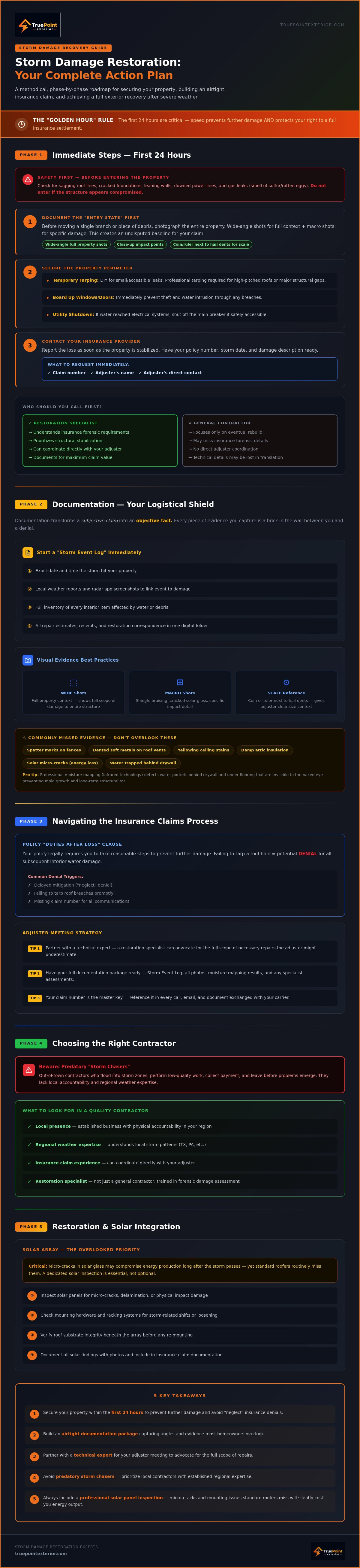
- Secure your property within the first 24 hours to prevent further damage and avoid insurance claim denials based on maintenance neglect.
- Build a logistical shield for your claim by documenting specific evidence and angles often missed during the storm damage restoration process.
- Prepare for the insurance adjuster meeting by partnering with a technical expert who can advocate for the full scope of necessary repairs.
- Identify and avoid predatory "storm chasers" by prioritizing local contractors with established regional weather expertise and physical accountability.
- Ensure a complete recovery by integrating a professional solar panel inspection to detect micro-cracks or mounting issues that standard roofers often overlook.
Immediate Steps: What to Do in the First 24 Hours
The first 24 hours after a severe weather event represent the "Golden Hour" of your recovery. Speed is essential, but it must be balanced with calculated safety. Acting quickly preserves the integrity of your property and protects your right to a full insurance settlement. Delaying initial mitigation often leads to "neglect" denials, where carriers refuse to pay for damage that could have been prevented by timely action. Your primary goal is to stabilize the structure while creating a clear evidence trail for your claim.
Before you step onto the property, conduct a thorough structural hazard assessment. Look for sagging roof lines, cracked foundations, or leaning walls. If the structure appears compromised, do not enter. Hiring a residential specialist for your storm damage restoration is significantly more effective than calling a general contractor. Restoration specialists understand the specific forensic requirements of insurance claims and the technical urgency of structural stabilization. They prioritize your home's immediate security while a general contractor may focus only on the eventual rebuild.
Securing the Property Perimeter
In storm zones across Texas and Pennsylvania, downed power lines and ruptured gas lines are common, life-threatening hazards. Never approach a fallen wire or enter a home that smells of sulfur or "rotten eggs." Once the area is cleared for safety, focus on temporary stabilization to prevent secondary damage. You must document the "Entry State" of your home before moving a single branch or piece of debris. Take wide-angle photos of the entire property and close-ups of specific impact points. This creates an undisputed baseline for your claim.
- Temporary Tarping: You can DIY small, accessible leaks, but professional tarping is recommended for high-pitched roofs or significant structural gaps.
- Boarding Up: Secure broken windows or doors immediately to prevent theft and water intrusion.
- Utility Shutdown: If you suspect water has reached electrical systems, shut off the main breaker if it's safe to reach.
Initial Contact with Your Insurance Provider
Report the loss to your carrier as soon as the property is stabilized. Have your policy number, the date of the storm, and a brief description of the damage ready for the first call. Every policy includes a "Duties After Loss" clause. This legal requirement mandates that you take reasonable steps to prevent further damage. Failing to tarp a hole in the roof could result in a denial for subsequent water damage to your interior.
Request a claim number immediately. This number is the master key for all future communication and documentation. Ask specifically for the name and contact information of the assigned adjuster. Having this information allows your restoration partner to coordinate directly with the carrier, ensuring no technical details are lost in translation. Prompt reporting sets a professional tone for the entire claim process and demonstrates that you are a proactive, responsible homeowner.
Documentation: Building Your Logistical Shield
Documentation transforms a subjective claim into an objective fact. It's your most powerful tool during storm damage restoration. Start a "Storm Event Log" immediately after the weather clears. Record the exact date and time the storm hit your property. Include local weather reports or screenshots from radar apps to establish a direct link between the event and the resulting damage. This log serves as the chronological backbone of your insurance file.
If the exterior envelope was breached, you must inventory every interior item affected by water or debris. Look for subtle signs like yellowing ceiling stains or damp insulation in the attic. Professional moisture mapping is critical for identifying hidden threats. It uses infrared technology to locate water trapped behind drywall or under flooring that the naked eye misses. Finding these pockets early prevents mold growth and long term structural rot.
Visual Evidence Best Practices
Capture "wide" shots to show the full context of the damage. Follow these with "macro" shots to highlight specific details like shingle bruising or cracked solar glass. Use a common object like a coin or a ruler next to hail dents to provide a clear sense of scale for the adjuster. Homeowners often miss subtle indicators like "spatter" marks on fences or dented soft metals on roof vents. Comprehensive documentation is the foundation of claim success. Don't forget to document the condition of your solar array, as micro-cracks can compromise your energy production long after the storm passes.
Tracking Repair Estimates and Receipts
Create a dedicated digital folder for all restoration correspondence and financial records. Save every receipt, including those for emergency tarps, plywood, or temporary lodging. These costs often qualify for reimbursement under the "Additional Living Expenses" (ALE) portion of your policy. You must also understand the financial math of your settlement. Actual Cash Value (ACV) pays the depreciated value of your property, while Replacement Cost Value (RCV) covers the current market price to replace items. Organizing these details early prevents settlement delays and ensures you aren't paying out of pocket for covered losses. If you're unsure how to categorize your evidence, seeking expert insurance claims assistance can streamline the entire recovery process.
Navigating the Insurance Claims Process as a Homeowner
The insurance claim is the most complex phase of storm damage restoration. While your documentation provides the evidence, the onsite adjuster meeting determines your funding. Most homeowners feel disadvantaged during this inspection because they lack technical training in structural forensics. You don't have to face this alone. Having a professional restoration partner present during the adjuster’s walkthrough ensures that every technical detail, from shingle granule loss to solar mounting integrity, is identified and recorded in real time.
Discrepancies in the "Scope of Work" are common. An adjuster might overlook essential line items like ice and water shields or specific ridge vent requirements. Identifying these gaps early prevents the financial "low-ball" offers that often frustrate homeowners in states like New Jersey or Rhode Island. If a claim is denied or undervalued, you have the right to request a re-inspection or enter into appraisal. A seasoned partner acts as your logistical shield, providing the technical data needed to challenge an inaccurate assessment.
The Role of a Professional Advocate
Restoration experts speak the specific language of insurance carriers. They use industry-standard estimating software to align their repair bids with the carrier’s expectations. This alignment reduces friction and accelerates approval times. When reviewing the adjuster's report, your advocate checks for missing components that are vital for a long-term fix. For more localized insights, you can review our specific advice on storm damage roof repair Pennsylvania to see how regional codes impact claim outcomes.
Supplementing the Claim
Restoration is rarely a static process. "Hidden damage" often reveals itself only after the teardown begins. You might find rotted roof decking or compromised rafter ties once the old materials are removed. In these scenarios, your contractor must file a "supplement." This is a formal request for additional funds to cover the newly discovered repairs. It's a standard part of the process that ensures your home is returned to its pre-storm condition while meeting all modern building codes in Texas or Connecticut. Your carrier is typically required to pay for these code-mandated upgrades if you have "Law and Ordinance" coverage in your policy. We handle the technical documentation for these supplements so you can focus on your family's safety.
Choosing Quality Storm Damage Restoration Contractors
After a severe weather event, your neighborhood will likely see an influx of out-of-state crews. These "storm chasers" follow weather patterns across the country. They lack regional accountability and often disappear once the initial work is complete. For homeowners in Pennsylvania and New Jersey, regional expertise is non-negotiable. Local contractors understand the specific freeze-thaw cycles and wind patterns that impact residential structures in the Northeast. Choosing a team with a residential-only focus ensures you receive specialized care tailored to your home’s unique needs rather than a one-size-fits-all commercial approach.
Spotting predatory sales tactics is essential for your property's security. Be wary of contractors who use high-pressure "sign now" techniques or offer to cover your insurance deductible. In many states, including Texas, it's illegal for a contractor to waive or pay a homeowner's deductible. Verifying professional credentials is your best defense. Look for manufacturer-backed certifications, such as GAF, which indicate the team has undergone rigorous training and maintains high installation standards. These certifications often allow for extended warranties that uncertified crews cannot provide.
Vetting for Reliability and Longevity
Reliability is proven through local history. Request references from specific neighborhoods in your area, such as Dallas or Philadelphia, to verify the contractor's track record. While it's tempting to choose the lowest bid, this often leads to the highest long-term cost due to hidden defects or poor material choices. A reputable contractor maintains a permanent local physical presence, holds all necessary state licenses, and possesses a solid warranty standing with their suppliers. This physical presence ensures they are available for follow-up service long after the storm clouds have cleared.
Contract Transparency and Warranties
Transparency starts with the written agreement. Your contract must be explicit about the scope of work, including details like debris removal and daily site cleanup. A comprehensive restoration warranty should cover both materials and workmanship for an extended period. Don't rely on verbal promises. Ensure every detail of the storm damage restoration plan is documented before work begins. If you need a partner who combines technical skill with ethical advocacy, you can schedule a professional storm damage repair consultation to review your options. This proactive step ensures your home is restored by specialists who are invested in your community's long-term resilience.
The Restoration Phase: Exterior Repair and Solar Integration
Physical storm damage restoration is where your recovery plan becomes a reality. This phase starts with structural stabilization and moves through the heavy lifting of exterior repairs. For modern homeowners, solar integration is the most critical variable in the process. Standard restoration crews often ignore how shingles and solar panels interact. We perform a specialized solar panel inspection to check for micro-cracks and mounting integrity. These tiny fractures are invisible to the naked eye but can significantly reduce your energy output over time if left unaddressed.
Coordinating a roof replacement with solar "detach and reset" services requires technical precision. We remove the array, install the new residential roofing system, and reset the panels with updated mounting hardware. This seamless transition protects your investment and ensures the roof's waterproofing remains uncompromised. Managing both systems under one roof prevents the scheduling delays that occur when you're forced to coordinate between separate roofing and solar contractors.
Restoring Your Home’s Energy Efficiency
Storms bring more than just wind and hail; they bring electrical risks. We assess your solar inverter health after lightning strikes or power surges to ensure your system is actually producing power. True Point Exterior manages the intersection of roofing and solar simultaneously. This dual expertise is vital because it ensures your solar warranty remains intact during exterior repairs. You won't have to mediate disputes between two different companies about who is responsible for a leak or a system failure. Our goal is to return your home to full functionality, including its energy production systems.
Interior Remodeling and Finishing
Once the exterior envelope is secure, we shift focus to the interior. We address the water stains, bubbling paint, and drywall damage that often follow a roof breach. This stage is more than just a repair; it's a chance for interior remodeling that improves your living space and increases property value. We handle the finishing touches that make your house feel like home again. After all repairs are finished, we perform a final walkthrough to ensure every detail meets our quality standards. Schedule your professional storm damage inspection with True Point Exterior to begin your comprehensive recovery plan today. Securing your Certificate of Completion marks the end of the process, giving you the confidence that your home is structurally sound and energy-efficient.
Secure Your Property’s Future with Expert Restoration
Effective recovery begins with proactive documentation and ends with a home that's stronger than it was before the storm. You now have a clear roadmap to navigate the complexities of insurance claims and structural repairs. Successful storm damage restoration requires a technical partner who understands both your roof's integrity and your solar system's performance. By prioritizing local expertise over out-of-state crews, you protect your warranty and your property value.
True Point Exterior acts as your reliable advocate throughout the entire recovery process. We provide expert insurance claims assistance and specialized solar support to residential clients in PA, TX, NJ, CT, and RI. Our team ensures that your home returns to its pre-storm condition with minimal stress for your family. Secure Your Home with a Professional Storm Inspection today to guarantee a thorough, high-quality restoration. You deserve a partner who values your home's long-term resilience as much as you do.
Frequently Asked Questions
How long do I have to file a storm damage claim in Texas?
Texans generally have one year to file a wind or hail claim under most standard policies. However, some specific policies or regional carriers in coastal zones might require notice within 90 days. You should review your policy's "Duties After Loss" section immediately. Delaying your filing can make it harder to prove that the weather event caused the specific damage. We recommend reporting your loss as soon as the property is stabilized to ensure compliance with all deadlines.
Can I choose my own restoration contractor, or does insurance pick one?
You have the absolute legal right to choose your own restoration contractor. Insurance companies often suggest "preferred providers," but these vendors frequently have pre-negotiated rates with the carrier. Selecting an independent local specialist ensures that your advocate’s primary loyalty is to your home’s structural integrity. We focus exclusively on residential projects in Pennsylvania and Texas, providing personalized care that national franchises often miss during large-scale weather events. Our team works for you, not the insurance company.
What happens if the insurance check is less than the contractor’s estimate?
It's common for an initial insurance check to be lower than a professional repair estimate. This usually happens because the adjuster missed specific line items or local building codes. We resolve these discrepancies by filing a "supplement," which is a request for additional funds backed by technical evidence. We provide the carrier with photos and local code requirements to justify the necessary costs. This ensures your storm damage restoration is fully funded without out-of-pocket surprises.
Do solar panels need to be replaced after a major hail storm?
Solar panels are built to be durable, but they aren't invincible. High-velocity hail can cause micro-cracks that compromise the system’s energy production without shattering the glass. We perform specialized inspections to check the mounting integrity and inverter health. If your roof needs replacement, we handle the "detach and reset" process. This ensures your solar warranty remains intact while the underlying structure is repaired. Don't assume panels are fine just because they look intact.
Will my insurance premium go up if I file a storm damage claim?
In most states, insurance companies cannot raise your individual premiums for filing a claim related to an "Act of Nature." Since you didn't cause the storm, you aren't penalized for the damage it inflicted. However, premiums in an entire zip code may rise if a major catastrophe affects the whole region. Filing your claim ensures you receive the benefits you've already paid for through your monthly premiums. It's a necessary step to protect your home's long-term value.
What is the difference between a public adjuster and a restoration contractor?
A public adjuster is a licensed professional who negotiates the financial settlement of a claim for a percentage of the payout. A restoration contractor focuses on the technical and physical recovery of the property. While we don't charge a fee to "adjust" your claim, we provide the expert documentation and construction estimates that adjusters use to determine your settlement. We act as your technical advocate throughout the physical storm damage restoration process.
Is wind damage covered differently than flood damage in Pennsylvania?
Standard homeowners policies in Pennsylvania cover wind and hail damage but almost always exclude flood damage. Wind damage refers to shingles being torn off or trees falling on the structure. Flood damage involves rising groundwater entering the home. If a storm causes a roof leak, it's typically covered as a wind event. However, if a nearby creek overflows into your basement, you need a separate flood insurance policy to receive compensation for those specific water losses.
How do I know if I have hidden storm damage on my roof?
Hidden damage often manifests as subtle "bruising" on shingles or hairline cracks in solar panels. You might see excessive shingle granules collecting in your downspouts or small dents on soft metal roof vents. These signs indicate that the protective layer of your roof is compromised. We use professional moisture mapping to find water trapped behind walls before it turns into mold. A professional inspection is the only way to confirm your home’s structural envelope is secure.
